Monday, November 27, 2023

Assignment Paper 202: Post Colonialism in 'Midnight's Children'

Hello readers, I'm writing this blog as an Assignment on Paper number 202 (Indian English Literature - Post Independence) assigned by Professor Dr. Dilip Barad sir, Head of the Department of English, Maharaja Krishnakumarsinhji Bhavnagar University.

Name: Gayatri Nimavat 

Paper: 202 (Indian English Literature - Post Independence)

Roll no: 06

Enrollment no: 4069206420220019

Email Id: gayatrinimavat128@gmail.com

Batch: 2022-24 (MA Semester - 3)

Submitted to: S. B. Gardi Department of English,Maharaja Krishnakumarsinhji Bhavnagar University 

Abstract:

"Midnight's Children" by Salman Rushdie is a masterful novel that intertwines historical events, magical realism, and personal narrative to depict India's journey from British colonial rule to independence. Through protagonist Saleem Sinai, born at the moment of independence, the novel explores identity, cultural hybridity, and historical truths in post-colonial India. Rushdie's storytelling challenges reality with magical realism, earning global acclaim. The work examines the relevance of post-colonialism, rooted in India's historical context, portraying the impact of British rule, the trauma of partition, and challenges of forging a new national identity. Saleem's character embodies cultural hybridity, and language serves as a tool of power and resistance. The narrative explores nationalism's evolution, critiques post-colonial government structures, and employs magical realism as a reflection of post-colonial reality. In essence, "Midnight's Children" illuminates the complexities of post-colonial societies and the quest for identity after colonialism through powerful storytelling.

Introduction:

Salman Rushdie's "Midnight's Children" is a captivating novel that weaves together historical events, magical realism, and personal narrative to chronicle the tumultuous journey of India from British colonial rule to independence and beyond. The story unfolds through the eyes of Saleem Sinai, an enigmatic narrator born at the stroke of midnight on August 15, 1947, the very moment India gained independence. Saleem discovers that he possesses telepathic powers, linking him to the 1,000 other children born during that same magical hour, all endowed with extraordinary abilities.

As Saleem's life intertwines with the nation's history, he navigates the complexities of postcolonial India, grappling with issues of identity, cultural hybridity, and the search for historical truth. The novel explores themes of partition, political turmoil, and the struggle to define India's postcolonial identity.

Amidst the grand narrative of India's transformation, Saleem's personal story unfolds, filled with love, loss, family struggles, and a relentless pursuit of self-discovery. His journey takes him from the bustling streets of Bombay to the remote corners of Kashmir, reflecting the vastness and diversity of the Indian subcontinent.

Rushdie's masterful storytelling blends historical events with fantastical elements, creating a unique narrative that challenges conventional notions of reality and truth. The novel's magical realism seamlessly integrates the ordinary with the extraordinary, mirroring the extraordinary transformations India undergoes during this transformative era.

"Midnight's Children" is a literary masterpiece that has garnered global acclaim, winning the Booker Prize in 1981. It is a profound exploration of postcolonial identity, national consciousness, and the enduring legacy of colonialism. Rushdie's captivating narrative and masterful use of language have cemented the novel's place as a cornerstone of postcolonial literature.

Post-colonialism and its relevance in literature :

Post-colonialism is a broad term encompassing a field of study that examines the cultural, historical, and political effects of colonialism on colonized societies, both during and after the period of colonial rule. It emerged in the 1970s as a critical response to traditional Eurocentric perspectives that often marginalized or ignored the experiences and voices of formerly colonized peoples.

Relevance of Post-colonialism in Literature:

Post-colonial literature plays a significant role in exploring and understanding the complexities of post-colonial societies. It provides a platform for marginalized voices to articulate their experiences, challenge dominant narratives, and reimagine their cultural identities.

Post-colonial literature grapples with questions of identity, particularly in the context of cultural hybridity, the fusion of different cultures and traditions resulting from colonialism. It challenges the notion of a singular, homogenous national identity and explores the diverse and often fragmented experiences of post-colonial subjects.

Post-colonial literature often employs the concept of cultural hybridity to challenge the binary divisions between colonizer and colonized, and between Western and non-Western cultures. It recognizes that cultural identities are fluid and constantly evolving, shaped by the interactions and exchanges between different cultures.

Post-colonial literature challenges the traditional Eurocentric narratives that dominate history, often presenting alternative perspectives and giving voice to marginalized experiences. It questions the assumptions and biases embedded in historical accounts, offering a more nuanced and inclusive understanding of the past.

Post-colonial literature often explores themes of power dynamics and resistance in post-colonial societies. It examines the ongoing struggles for autonomy, self-determination, and cultural reclamation in the aftermath of colonialism.

Post-colonial literature often experiments with language and form, breaking away from traditional Western literary conventions. It incorporates elements of oral traditions, indigenous languages, and non-Western literary forms to create unique and expressive narratives.

Post-colonial literature serves as a vital tool for understanding the cultural, historical, and political landscapes of post-colonial societies. It challenges dominant narratives, gives voice to marginalized experiences, and offers critical insights into the complexities of post-colonial identity and cultural hybridity.

Historical Context:

Salman Rushdie's "Midnight's Children" is deeply rooted in the tumultuous historical context of India's post-colonial era, a period marked by the struggle for independence, partition, political turmoil, and the search for a new national identity.

British Colonial Rule and the Struggle for Independence:

The novel's protagonist, Saleem Sinai, is born at the stroke of midnight on August 15, 1947, the very moment India gains independence from British colonial rule. This symbolic connection between Saleem's birth and the nation's birth highlights the inextricable link between individual lives and the broader historical narrative.

Rushdie vividly portrays the euphoria and hope that accompanied India's independence, as well as the underlying tensions and complexities that emerged in the aftermath of colonial rule. The novel delves into the political maneuverings, the clash between different ideologies, and the challenges of building a new nation amidst diverse cultures and traditions.

Partition and Its Devastating Impact:

The novel poignantly captures the tragedy of India's partition, the division of the subcontinent into India and Pakistan, which triggered mass migrations, violence, and the displacement of millions of people. Saleem's family is directly affected by partition, as they are forced to flee their home in Kashmir, reflecting the personal and collective trauma inflicted by this historical event.

Rushdie's depiction of partition challenges the simplistic narratives that often portray it as a mere political event. The novel highlights the human cost of partition, the disruption of lives, the loss of homes and loved ones, and the deep scars left on the collective psyche of both nations.

Political Turmoil and the Search for Stability:

The novel traces India's journey through the tumultuous years following independence, marked by political upheavals, social unrest, and the search for a stable and democratic nation. Rushdie explores the rise of Indira Gandhi's authoritarian rule, the Emergency period, and the ongoing struggle for political stability and social justice.

The novel's characters embody the political and social tensions of the time, grappling with questions of national identity, democracy, and the legacy of colonialism. Saleem's experiences, as he witnesses and becomes entangled in political events, reflect the challenges of forging a new nation amidst the complexities of post-colonial India.

Hybridity and the Redefinition of Identity:

Rushdie's novel challenges the notion of a singular, homogenous Indian identity. He embraces the concept of hybridity, the fusion of different cultures and traditions, reflecting the diverse tapestry of Indian society. Saleem's character embodies this hybridity, as he is born to an Indian mother and an English father, raised in a multicultural household, and constantly negotiating his identity in a post-colonial world.

In Salman Rushdie's novel "Midnight's Children," the characters grapple with their identities in the aftermath of colonial rule, navigating the complexities of cultural hybridity and the clash between indigenous traditions and Western influences. The novel's setting, post-colonial India, provides a fertile ground for exploring these themes as the characters seek to define themselves in a rapidly changing world.

Saleem Sinai: A Hybrid Identity:

Saleem Sinai, the novel's protagonist, embodies the hybridity of post-colonial identity. Born at the stroke of midnight on India's independence day, he is both a product of the colonial era and a child of the new nation. His mixed parentage, with an Indian mother and an English father, further complicates his sense of self.

Saleem's identity is shaped by his interactions with people from diverse backgrounds, reflecting the cultural mosaic of India. He grows up in a neighborhood that represents a microcosm of the country, with people from different religions, castes, and ethnicities. This exposure to diverse cultures and traditions influences his worldview and his understanding of his own identity.

Cultural Hybridity :

The novel vividly portrays the cultural hybridity that emerged in India after centuries of British rule. Western influences, such as English language, education, and social norms, intermingled with indigenous traditions and practices. This fusion created a unique cultural landscape, reflected in the characters' lives and choices.

Saleem's family, for instance, exemplifies this cultural hybridity. His mother, Ayesha, is a staunch traditionalist, while his father, Aamer, is more Westernized. Saleem's upbringing reflects this blend of traditions, with Hindu rituals and Western schooling coexisting in his life.

Language and Power:

Language plays a multifaceted role in post-colonial societies, serving as a tool of power, a medium for cultural expression, and a site of resistance against colonial legacies. In the aftermath of colonial rule, language often becomes a contested terrain where the dominance of the former colonizer's language intersects with the resurgence of indigenous languages and the emergence of hybrid linguistic forms.

During the colonial era, the language of the colonizer was imposed upon the colonized population, serving as an instrument of control and cultural assimilation. The English language, for instance, became the language of administration, education, and social advancement in many post-colonial societies. This linguistic dominance reinforced the power dynamics of colonialism, marginalizing indigenous languages and perpetuating cultural hierarchies.

In post-colonial contexts, language continues to wield power, shaping access to opportunities, influencing social mobility, and defining cultural identities. The ability to speak the dominant language, often associated with prestige and modernity, can open doors to education, employment, and political participation. On the other hand, fluency in indigenous languages can provide a sense of cultural identity, connection to community heritage, and resistance against linguistic homogenization.

Nationalism and Independence:

Nationalism is a central theme in "Midnight's Children," as the novel traces the evolution of India's national identity from the colonial era to the post-colonial period. The novel opens with India's birth at midnight on August 15, 1947, a moment of euphoria and hope for the newly independent nation.

However, Rushdie also explores the darker side of nationalism, as the characters grapple with the challenges of building a new nation amidst diverse cultures, political ideologies, and lingering colonial legacies. The novel highlights the tensions between unity and diversity, the struggle for democracy, and the search for a new national narrative.

The characters in "Midnight's Children" hold a range of perspectives on independence and the post-colonial era. Saleem Sinai, the novel's protagonist, is initially filled with optimism and a sense of belonging to the new India. However, his disillusionment grows as he witnesses the political turmoil, social unrest, and the erosion of democratic values in the years following independence.

Other characters, such as Saleem's parents, Ayesha and Aamer, represent different facets of the nationalist movement. Ayesha is a staunch traditionalist, deeply rooted in Indian culture and values, while Aamer is more Westernized and skeptical of the new nation's promise. Their contrasting perspectives reflect the diverse strands of thought that contributed to India's nationalist movement.

Post-Colonial Structures:

Post-colonial Government and Institutions:

Salman Rushdie's novel "Midnight's Children" offers a critical and often satirical portrayal of post-colonial structures, particularly the government and institutions, in India. The novel traces the tumultuous journey of India from colonial rule to independence and beyond, highlighting the challenges and contradictions that emerged as the nation sought to establish its own identity and governance systems.

The Flawed and Fallible Post-colonial State:

Rushdie depicts the post-colonial Indian government as flawed, fallible, and susceptible to manipulation. The novel's protagonist, Saleem Sinai, witnesses firsthand the excesses and corruption that plague the new administration, particularly during the Emergency period under Indira Gandhi's authoritarian rule.

The government's actions, such as forced sterilizations, suppression of dissent, and the erosion of democratic principles, raise questions about the legitimacy and effectiveness of the post-colonial state. Rushdie's portrayal challenges the idealized notion of a benevolent and representative post-colonial government.

Magical Realism as a Literary Device:

In Salman Rushdie's novel "Midnight's Children," magical realism emerges as a powerful narrative strategy that complements and enhances the exploration of post-colonial themes. The novel seamlessly intertwines the ordinary with the extraordinary, blurring the boundaries between reality and fantasy, and creating a unique and captivating reading experience.

Magical Realism as a Reflection of Post-colonial Reality:

Magical realism, with its blend of the mundane and the magical, serves as an apt reflection of the post-colonial experience. The characters in the novel inhabit a world where the boundaries between reality and fantasy are fluid, mirroring the complexities and contradictions of post-colonial societies.

The presence of magical elements, such as Saleem's telepathic powers and the Midnight Children's collective consciousness, allows Rushdie to explore themes of national identity, cultural hybridity, and the search for historical truth in a non-linear, imaginative manner.

Magical Realism and the Post-colonial Imagination:

Magical realism aligns with the post-colonial imagination, which seeks to break away from the Eurocentric and often rigid structures of traditional storytelling. It allows for the exploration of alternative narratives, the incorporation of folklore and oral traditions, and the creation of a unique literary landscape that reflects the cultural hybridity of post-colonial societies.

Conclusion:

In essence, "Midnight's Children" stands as a testament to the power of storytelling to illuminate the complexities of post-colonial societies and the ongoing struggle for identity, self-determination, and cultural reclamation in the aftermath of colonial rule.

Words : 2266


Assignment Paper 201: Class and Caste Conflict in 'The Curse or Karna'

Hello readers, I'm writing this blog as an assignment on Paper number 201 (Indian English Literature - Pre Independence) assigned by Professor Dr. Dilip Barad sir, Head of the Department of English, Maharaja Krishnakumarsinhji Bhavnagar University.

Name: Gayatri Nimavat 

Paper: 201 (Indian English Literature - Pre Independence)

Roll no: 06

Enrollment no: 4069206420220019

Email ID: gayatrinimavat128@gmail.com

Batch: 2022-24 (MA Semester - 3)

Submitted to: S. B. Gardi Department of English,Maharaja Krishnakumarsinhji Bhavnagar University 

Abstract:

Navigating the intricate tapestry of T. P. Kailasam's "The Curse of Karna," this comprehensive exploration delves into the vivid portrayal of caste and class conflict within the Mahabharata. Karna's life journey becomes a poignant lens through which caste and class intricacies shape destinies, influencing moral quandaries, loyalty, and societal expectations. Real-life parallels in contemporary society, spanning education, reservation policies, marriage, healthcare, and urban development, illuminate the enduring relevance of these themes. The exploration concludes with a call to confront biases, fostering inclusivity and steering society towards a more equitable future. This multifaceted examination provides a comprehensive understanding of the interplay between caste and class conflicts, both within the literary realm and in the context of present-day social complexities.

Introduction:

Caste and class, deeply ingrained in Indian society, have been perennial sources of social stratification and conflict. In T. P. Kailasam's "The Curse of Karna," these themes are vividly portrayed through the life of the protagonist, Karna. This exploration extends beyond the literary realm, resonating with contemporary social realities. This essay delves into the nuances of caste and class conflict in Kailasam's play and draws parallels with present-day scenarios, particularly in the realms of education, the reservation system, marriage, and the perpetuation of social barriers.

What is Caste?

Ketekar in his book "History of caste in India" -'Caste is a social group having two characteristics (a) membership is confined to those who are born of members & includes all persons no born (b) the members are forbidden by an inexorable social law to marry outside the group."

In his book The Caste System Of Northern India E. Blunt gave the definition that - Caste is an endogamous group bearing a common name, membership of which is hereditary, imposing on its members certain restrictions in the matter of social intercourse, either following a common traditional occupation and claiming a common origin & generally regarded as forming a single homogenous community.

What is class?

Max weber - held that "classes are aggregate of individuals who have the same opportunities of acquiring goods. The same exhibited standard of lining.

Mac Iver & Page "A social class is any portion of a community marked off from the rest by social status 'Ongburn & Nimk off. A social class is the aggregate of persons having essentially the same social status in a given society." i.e. a class consciousness.

Class and Caste conflict in 'The Curse or Karna':

Ketekar and Blunt's definitions of caste provide a framework for understanding Kailasam's portrayal of caste in the play. Karna, born to a lower caste, faces discrimination that shapes his destiny. The caste system is depicted as an unyielding force, restricting Karna from marrying outside his caste and imposing societal limitations.

Max Weber's concept of class as individuals with similar opportunities aligns with Kailasam's narrative. Karna's journey unfolds against a backdrop of societal distinctions, where opportunities are constrained by one's hereditary status. The play, thus, becomes a canvas on which class disparities are painted, influencing characters' choices and trajectories.

"The Curse of Karna" by T. P. Kailasam delves deep into the intricate dynamics of class and caste conflict within the framework of the Mahabharata, providing a nuanced exploration of societal divisions. Karna, the central character, becomes a prism through which the playwright unravels the complexities of a society deeply entrenched in caste norms, where birth dictates one's status and opportunities. The play vividly portrays the discrimination faced by Karna due to his low-caste birth, establishing caste-based exclusion as a central theme. Despite Karna's exceptional skills as a warrior, his pursuit of education is met with resistance, illustrating historical biases that denied individuals from lower castes access to knowledge and skills.

Education becomes a focal point for exploring caste conflict as Karna faces rejection from the Brahmin guru Raama. The denial of certain powerful knowledge to Karna based on his caste underscores the societal restrictions that limit educational opportunities. Kailasam uses this narrative to highlight the social barriers that impede upward mobility for individuals from marginalized castes, even when they possess significant talents and potential for greatness. The struggle for education becomes emblematic of the broader societal challenges related to caste-based discrimination.

Karna's loyalty to Duryodhana, a Kshatriya prince, introduces a layer of class struggle within the play. Karna's allegiance challenges established norms of loyalty based on caste affiliations, highlighting the tension between individual agency and the rigid class structures that govern relationships in the Mahabharata. This loyalty, grounded in personal convictions, serves as a powerful commentary on the complexities of class dynamics within the narrative.

Moral dilemmas further complicate the narrative, shedding light on how societal expectations and caste norms influence Karna's choices. The play prompts the audience to reflect on the ethical quandaries faced by individuals navigating a society bound by caste restrictions. Karna's internal struggles become emblematic of the broader moral challenges inherent in a caste-based social order, questioning the legitimacy of societal expectations that restrict individual freedom.

The curse placed on Karna serves as a poignant symbol of the pervasive nature of social injustice and discrimination. Originating from a moment of caste-related injustice, the curse encapsulates the broader societal forces that conspire against Karna. It becomes a metaphor for the enduring consequences of caste conflict, illustrating the inescapable influence of societal norms and the profound impact of discrimination on individual destinies.

The interactions between characters from different castes in the play reveal power dynamics and prejudices embedded in the social fabric. Karna's interactions with higher-caste characters highlight the societal prejudices that shape relationships. Kailasam employs these interactions to illustrate how caste divisions permeate every aspect of life, influencing not only individuals but also the dynamics between characters. The play becomes a microcosm of a society where caste-based hierarchies dictate social interactions and relationships, exposing the systemic nature of discrimination.

Through the lens of the Mahabharata, Kailasam critiques the caste-based social structures prevalent in ancient India. His portrayal of Karna's struggles serves as a commentary on the injustices perpetuated by rigid caste norms. The play becomes a platform for questioning societal values, norms, and the impact of caste on individual destinies. Kailasam's work transcends its historical context, offering a timeless critique of societal divisions and prompting the audience to reflect on the universality of these themes beyond the ancient epic.

"The Curse of Karna" is a profound exploration of class and caste conflict within the Mahabharata. Kailasam's masterful storytelling and nuanced character portrayals provide a lens through which societal divisions are scrutinized. The play resonates not only as a commentary on ancient Indian society but also as a reflection of enduring societal challenges related to discrimination, loyalty, and moral dilemmas. Through the intricacies of Karna's journey, the audience is compelled to confront the complexities of class and caste dynamics, prompting a deeper understanding of societal structures and the human experience.

Caste/Class Conflict in Education:

The play unveils the caste conflict within the education system. Raama's refusal to impart knowledge to Karna due to his supposed low birth exemplifies how caste prejudices obstruct learning opportunities. Similarly, Guru Drona's denial of education to Karna further accentuates the barriers faced by individuals based on their caste. These instances mirror historical inequities where education was reserved for specific castes, perpetuating a cycle of social inequality.

In contemporary times, the privatization of education becomes a breeding ground for class conflict. The unequal distribution of resources in the education sector widens the gap between the privileged and the marginalized, reinforcing disparities reminiscent of historical caste-based exclusions.

Caste-Based Reservation System in India:

Kailasam's work aligns with the ongoing debate on caste-based reservation in India. Draupadi's rejection of Karna's proposal at the swayamvar on the basis of his caste resonates with the societal reluctance to break free from deeply entrenched prejudices in contemporary society. The essay draws attention to the necessity of reservation policies, emphasizing their role in addressing historical injustices and promoting inclusivity.

Class and Caste Conflict in Marriage:

The swayamvar of Draupadi serves as a microcosm of the broader caste conflict in the play. Karna, despite meeting the stipulated conditions, faces rejection solely due to his lower caste. This episode echoes the societal resistance against inter-caste marriages, where social identity often takes precedence over merit and capability.

In the present context, the essay highlights persisting social barriers to inter-caste marriages. The reluctance to accept unions beyond caste boundaries underscores the endurance of historical prejudices. Drawing on Gayatri Chakravorty Spivak's notion that the subaltern cannot speak, the essay emphasizes the silencing of voices within marginalized communities, particularly in matters of love and marriage.

Humiliation and Subaltern Voices:

The humiliating episode of Draupadi's disrobing in the gambling hall accentuates the class conflict prevalent in the Mahabharata. Karna's attempt to intervene is thwarted by reminders of his lower caste identity, exemplifying the suppression of subaltern voices. This echoes Spivak's concept, emphasizing how those on the fringes of society are often denied agency and voice.

In contemporary society, the persistence of class and caste conflicts is evident across various dimensions, reflecting deeply ingrained social structures. Employment and workplace discrimination serve as poignant examples of these issues. Individuals from marginalized castes often encounter biases during job interviews or promotions, hindering their professional growth. The discriminatory practices are not confined to anecdotal instances but extend to systemic biases. For instance, a study conducted by the Centre for Equity Studies in India revealed that individuals from lower castes face widespread discrimination in the job market, with higher chances of being denied jobs despite having similar qualifications as their higher-caste counterparts. Similarly, economic class plays a pivotal role in shaping employment opportunities, contributing to wage gaps and career disparities. Individuals from lower-income backgrounds often find it challenging to access high-paying jobs, perpetuating economic class divides.

Educational disparities further highlight the complexities of caste and class conflicts. Students from marginalized castes often encounter discrimination and unequal access to educational resources, impacting their academic performance. This phenomenon is not limited to rural areas; even in urban centers, instances of caste-based discrimination in schools persist. A study published in the "Economic and Political Weekly" found that Dalit children (those belonging to historically marginalized castes) face discrimination in educational institutions, affecting their overall development. On the other hand, economic class disparities in education are palpable, with lower-income families struggling to afford quality education. Private schools, often perceived as providing better education, can be financially inaccessible for families from economically disadvantaged backgrounds, perpetuating educational inequalities based on economic class.

Reservation policies in India, designed to address historical caste-based discrimination, exemplify the intricate interplay between caste and class. While these policies aim to rectify historical injustices, they face resistance, with arguments that they contribute to reverse discrimination. A case in point is the ongoing debate surrounding affirmative action in educational institutions and government jobs. Critics argue that merit-based selection should prevail over caste-based reservations. In contrast, proponents emphasize the necessity of such policies to counteract centuries of systemic oppression. The conflict mirrors the broader societal struggle to balance the rectification of historical injustices with concerns about meritocracy.

Similar debates emerge around class-based affirmative action, revealing conflicts over social welfare programs. For example, discussions about means-tested social welfare programs often center around whether they create dependency or empower individuals to break the cycle of poverty. These debates highlight the nuanced challenges of addressing economic class disparities, with tensions arising between the desire to provide assistance and concerns about the long-term impact on self-sufficiency.

Inter-caste and inter-class marriages provide another lens through which to examine societal conflicts. Societal opposition to unions that transcend caste or economic class boundaries remains a significant challenge. Despite legal strides, families often resist such marriages due to deeply ingrained social norms. A real-life example is the story of Khushboo and Shankar, a couple from different castes in India who faced opposition from their families. Their journey, documented by various news outlets, sheds light on the persistent societal resistance to breaking caste barriers in the context of relationships and marriage.

Access to healthcare is yet another arena where both caste and class dynamics come into play. Individuals from marginalized castes may face discriminatory practices, affecting the quality of care they receive. A study published in the "Journal of Social Inclusion Studies" found that Dalits in India experience discrimination in healthcare settings, leading to delayed or inadequate medical attention. Economic class also influences access to healthcare services. Individuals from lower-income backgrounds often struggle to afford quality healthcare, contributing to disparities in health outcomes based on economic status. Real-life instances abound, such as families in economically disadvantaged neighborhoods facing challenges in accessing healthcare facilities, exacerbating health disparities.

Urban gentrification provides a tangible illustration of the intersectionality of caste and class conflicts. Gentrification, often associated with urban renewal projects, can disproportionately impact historically marginalized communities. A study conducted by the National Community Reinvestment Coalition in the United States found that gentrification tends to displace lower-income communities, leading to the loss of affordable housing and cultural identity. In India, urban development projects have been criticized for displacing slum communities, often inhabited by lower-caste individuals, without adequate compensation or relocation plans. These instances highlight how economic class and historical caste dynamics converge, leading to social tensions and conflicts over urban development initiatives.

The intricate interplay between caste and class conflicts in contemporary society is evident across various spheres, from employment and education to healthcare and urban development. Real-life examples underscore the persistent challenges and the need for holistic approaches to address systemic inequalities. Understanding these complexities is essential for informed discourse and effective interventions aimed at fostering inclusivity, addressing historical injustices, and promoting social justice in the present day.

Conclusion:

In conclusion, T. P. Kailasam's "The Curse of Karna" serves as a profound exploration of caste and class conflict within the framework of the Mahabharata. The essay has traversed through various facets of the play, drawing connections with contemporary issues in education, reservation policies, marriage, and the perpetuation of social barriers. Through Karna's journey, the play becomes a mirror reflecting the enduring struggle against entrenched societal divisions. The echoes of historical injustices reverberate in modern India, urging society to confront its deep-rooted biases and strive for a more inclusive future. 

References:

"Class System." Class System, Definition Of Class, Class System Sociology, Class System Definition Sociology, Difference Between Caste And Class System, Civil Service India, https://www.civilserviceindia.com/subject/Sociology/notes/class-system.html.

Ketkar, S. V. "History of Caste in India: Ketkar, S.V.: Free Download, Borrow, and Streaming." Internet Archive, Public Resource https://archive.org/details/in.ernet.dli.2015.532372

Word Count: 2410


Sunday, November 19, 2023

MKBU Youth Festival 2023

Hello readers, Today, I'm thrilled to share insights about the spectacular 31st Inter College Youth Festival 2023 hosted by Maharaja Krishnakumarsinhji Bhavnagar University. Organized by the Department of Physical Education, this edition, titled 'Man Bhavan Yuvak Mahotsav - 2023,' centered around the theme 'Nari Shakti Vandana' and unfolded from the 3rd to the 5th of November.

Let's kick off with the vibrant Kala Yatra, a procession from Shamaldas Arts College to J.K. Sarvaiya Group of College on the 2nd of November. Each college showcased unique themes during the procession, ranging from technology to women empowerment. Our department passionately presented the theme of male dominance and women empowerment.

The Kala Yatra route included stops at Shamaldas Arts College, Central Salt, Aatabhai Chowk, Rupani Circle, Sardarnagar, Swaminarayan Gurukul, and concluded at J.K. Sarvaiya Group of College.


The Youth Festival's inauguration took place at the Amphitheater on the 3rd of November, followed by diverse competitions spanning three stages: Amphitheater (Mukhya Manch), Atal Auditorium (Natya Manch), New Court Hall, External Department, and English Department.

Atal Auditorium:

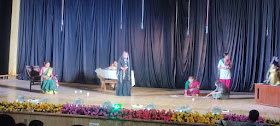
Theater events, my personal favorite, showcased captivating performances in skits, one-act plays, classical dances, monologues, mime, and mimicry at the Atal Auditorium.

Amphitheater:

Moving to the Amphitheater, folk songs and dances celebrated cultural heritage, while Western group and solo songs added a modern twist.

New Court Hall:

The New Court Hall echoed with the melodious tunes of Sugam Geet and Bhajans, as elocution addressed thought-provoking subjects like artificial intelligence, environmental conservation, and global terrorism.

External Department:

External Department events featured on-the-spot painting, paper collages, clay modeling, cartooning, poster making, rangoli, installations, and photography, each with a unique theme.

English Department:

The English Department hosted poetry and essay writing, newspaper cuttings, and an array of thought-provoking topics.

Let's see the events of Amphitheater:

Folk Song:

Delve into the rich tapestry of folk songs, timeless melodies that echo through generations within a community or culture. These musical gems serve as oral traditions, carrying the essence of experiences, customs, and values unique to their origin. Passed down through the ages, folk songs evolve organically as they weave stories of love, labor, historical events, and the art of storytelling.

Folk Dance:

Embark on a journey into the world of folk dance, where traditional movements and rhythms echo the cultural and social traditions of specific regions or communities. These dances, born from the tapestry of history, rituals, and everyday life, are a living testament to the heritage of the performers. Passed down through generations, folk dances are characterized by distinctive steps, movements, and a symphony of music that encapsulates the spirit of a community.


Western group and solo song :

Western group song in a performance context likely refers to a musical performance where a group of individuals collaboratively sings a song from a Western music genre. Western music encompasses various genres such as rock, pop, country, jazz, and more.


Transitioning from the captivating theses events at the Amphitheater, let's now explore the vibrant offerings at the Atal Auditorium.

Skit:

The theater events commenced with engaging skits, short and humorous plays performed by various colleges. These acts, whether scripted or improvised, aimed to entertain through comedy or satire. As an avid observer, I immersed myself in the diverse themes presented by each college, capturing the essence of this dynamic theatrical experience.


One Act Play:

Enter the world of One Act Plays, where a full-fledged drama unfolds seamlessly in a single act, eschewing intermissions. Diverging from the multi-act structure of longer plays, these succinct performances are crafted to deliver a compelling theatrical narrative in one continuous stretch. Emphasizing specific themes, ideas, or situations, One Act Plays distill a potent and concise theatrical experience, showcasing the creative prowess of the participating colleges. Let's explore the captivating performances that brought this unique storytelling format to life on the stage.


Classical Dance:

Step into the world of Classical Dance, a timeless art form rooted in cultural traditions, boasting a rich history and well-defined techniques. These dances, entrenched in specific cultures, showcase a vocabulary of movements, positions, and gestures, blending precise footwork, expressive hand gestures, intricate facial expressions, and elaborate costumes. From the classical dance spectrum, exemplified by styles like Bharatanatyam and Kathak in India, colleges brought these cultural treasures to life through captivating performances. Witness the grace and beauty that unfolded on the stage through the lens of classical dance.


Mono Act:

Within the theatrical realm, a mono Act takes center stage—a solo performance where a character delivers an uninterrupted speech, baring their innermost thoughts, emotions, or experiences directly to the audience or fellow characters. It serves as a powerful tool, offering a glimpse into a character's psyche, conveying essential plot elements, or providing crucial background information. Monologues, showcased in a myriad of theatrical genres, become a canvas for actors to display their prowess and playwrights to weave intricate layers into the narrative. Witnessing this artistry, Pooja Bhuwa from our department delivered a standout performance in the realm of mono act. 


Mime:

Enter the theatrical enchantment of Mime, a captivating performance art where actors narrate stories, embody characters, or express ideas solely through physical movements and gestures, eschewing spoken words. Mime is a dance of exaggerated and expressive body language, coupled with facial expressions, creating a visual symphony that communicates profoundly with the audience. The silent narratives unfolded by all colleges in mime not only delivered exceptional performances but also conveyed poignant messages. Allow me to unveil glimpses of these mesmerizing Mime performances crafted by the talented colleges.


Mimicry:

Dive into the theatrical finesse of Mimicry, a craft where performers adeptly imitate or replicate the mannerisms, voices, and behaviors of others. Within the realm of performance art, actors engage in this skill, mirroring the characteristics of specific individuals, often injecting humor or adopting impersonation. Mimicry extends to replicating accents, speech patterns, physical gestures, and facial expressions to craft an entertaining and recognizable portrayal of the target. Unlike mime, which relies on non-verbal communication, mimicry delves into the art of imitating both vocal and behavioral nuances. Witnessing this artistry, Jay Solanki from our college delivered an exceptional mimicry performance, adding a touch of brilliance to the theatrical canvas.


Let's now catch a glimpse of the enchanting events hosted at the New Court Hall:

Sugam Geet:

Step into the realm of Sugam Sangeet, a facet of Indian music that translates to "easy" or "pleasing" melodies. This genre embodies popular and accessible songs characterized by melodious tunes and straightforward lyrics. Often synonymous with light music, Sugam Sangeet captivates a broad audience with its simplicity, offering a musical journey through themes of love, emotions, and everyday life.

Hardi from our department graced the stage, contributing a performance that resonated with the soul of Sugam Geet.

Bhajan:

Immerse yourself in the sacred melodies of Bhajans, devotional songs that echo with expressions of love and reverence for deities in the Hindu tradition. These hymns form a tapestry of religious music, sung to praise gods, goddesses, and spiritual themes. Whether steeped in tradition or composed in more contemporary tones, Bhajans stand as integral components of religious ceremonies, festivals, and the devotional practices that enrich Hindu culture.

Rinkal Danger from our department graced the stage, delivering a performance that beautifully echoed the spiritual essence of these devotional songs.

Elocution:

Elocution refers to the skill of clear and expressive speech, often with a focus on pronunciation, articulation, and vocal delivery. It is the art of effective and persuasive public speaking or the study of formal speaking in pronunciation, grammar, style, and tone. Elocutionists aim to communicate their message clearly and convincingly, paying attention to aspects such as voice modulation, intonation, and appropriate gestures.

Subjects :

• 'આર્ટિફિશિયલ ઇન્ટેલિજન્સ: કેટલું પડકારજનક?'    

• 'યત્ર નર્યાત્સુ પૂજ્યંતે'    

• 'ચાલો વૃધ્ધાશ્રમ ઘટાડીએ'    

• 'પર્યાવરણ અને માનવ: એક સિક્કાની બે બાજુ'   

•'Global Terrorism: Implications and Solutions' 

• 'વૈશ્વિક આતંકવાદ: અસરો અને ઉકેલો'     

• 'बुलंद भारत की बुलंद तसवीर'

Trushali Dodiya from our department participated in Elocution and gave a wonderful performance.

On the spot painting, Paper collage, Clay modelling, cartooning, poster making, Rangoli, Installation, Photography, these events were held in the External Department.

Poetry writing, Quiz, Essay writing, these competitions were held in the Department of English.


This Youth Festival was not just about competitions; it was a holistic experience of creativity, expression, and celebration. Volunteers played a crucial role, and participants were not only treated to a feast for the senses but also provided with essential amenities.

As the curtains close on this unforgettable event, we extend our gratitude to everyone who contributed to making the 31st Inter College Youth Festival 2023 a resounding success. Until the next celebration, thank you for joining me on this journey through the vibrant tapestry of talent and culture!