This blog is Assignment writing on paper no-101( Literature of the Elizabethan and Restoration Periods) assigned by Professor Dr. Dilip Barad sir, Head of the English Department of Maharaja Krishnakumarsinhji Bhavnagar University.
Name: Gayatri Nimavat
Paper: Literature of the Elizabethan and Restoration Periods
Roll no: 09
Enrollment no: 4069206420220019
Email ID: gayatrinimavat128@gmail.com
Batch: 2022-24 (MA Semester - 1)
Submitted to: S. B. Gardi Department of English,Maharaja Krishnakumarsinhji Bhavnagar University
Analysis of the Hamartia of Macbeth. Compare it with other tragic heroes like Hamlet, Othello, King Lear, Oedipus.
Introduction:
Hamartia is a literary device that refers to the tragic flaw of a main character in a story, which ultimately leads to the character's downfall. Errors of judgement or specific character traits like excessive pride, greed, or jealousy can be a character's fatal flaw or lead to a reverse of fortune.
Aristotle introduced the term casually in the Poetics in describing the tragic hero as a man of noble rank and nature whose misfortune is not brought about by villainy but by some “error of judgment”. This imperfection later came to be interpreted as a moral flaw, such as Othello's jealousy, Hamlet's indecisiveness, Macbeth's ambition, Antony's irresponsibility, Qedipus's Unknowingly wrongdoing although most great tragedies defy such a simple interpretation. Most importantly, the hero’s suffering and its far reaching reverberations are far out of proportion to his flaw. In a sense Aristotle is trying to sit on a fence, he wants a tragic hero who is neither very bad nor very good. Hamartia comes in to provide the fence to sit on so that Aristotle can satisfy his concept of the emotional effect of a tragic plot, his moral sense, and his feeling that there must be necessity in tragic causation.
Definition of Hamartia:
It is now generally agreed that Hamartia in Aristotle's Poetic, means 'mistake of fact'. A story begins with a rich and powerful hero, neither exceptionally virtuous nor villainous, who then falls into misfortune by a mistake or error.
Hamartia is a key aspect of the tragic hero that starts out as a positive one, which later changes and ends up being detrimental to the tragic hero, and is the root of his collapse. The tragic flaw is also known as Hamartia. In Aristotelian tragedy, the Hamartia was more obvious, such as in Oedipus the King, however in Shakespearean tragedy, the flaw is less evident and sometimes unrecognisable if not studied cautiously.
The tragic flaw is something very bad in a tragic hero which causes a tragedy and makes the hero deserve what happens to him, even though the hero may have many desirable traits in addition to his flaw. This may be called the sin-punishment concept of the flaw.
The best tragedy is so composed as to arouse pity and terror. Firstly, it is clear that morally good men must not be shown passing from good fortune to bad, this does not arouse pity or fear but is repulsive. Nor must a morally vicious man be shown passing from bad fortune to good, for this does not satisfy our human feeling Nor does it arouse pity or fear. Nor again must the very crooked man be shown falling from good fortune into bad, this arrangement would satisfy human feeling, but would not arouse pity or fear. For pity is concerned with unmerited misfortune, fear with a character like ourselves. There remains the intermediate kind of character, not pre-eminent in moral excellence, nor falling into misfortune through vice and depravity, but through some Hamartia, being one of great reputation and good fortune, e.g. Oedipus, Macbeth, Othello, Hamlet, etc. It follows that the well constructed plot is single rather than double, the change being from good fortune to bad, not vice versa, not through viciousness but through a substantial error, the agent being either of the kind specified or better rather than worse than that.
The senses of Hamartia can be grouped under three main headings:
1. Mistake or miscalculation
2. Error of judgment
3. Moral error which is not serious enough to be wickedness or sin
Aristotelian hamartia to an analysis of Shakespearean tragic characterization and tragic causation:
1. Sometimes the tragic protagonist is more deeply flawed than Aristotelian hamartia would permit and indeed deserves what happens to him.
2. A character's contribution to his own tragedy may be through his total personality, his virtues as well as his flaws,
3. The flaws in the character of a tragic hero may be so deeply integrated with his virtues that they cannot be separated from his virtues except through violent abstraction.
4. Sometimes a virtue may be so twisted that it has the effect of a vice or defect without being inherently a vice or defect.
5. Sometimes the emphasis is upon the imperfections of the world rather than upon the hamartia in the hero as a cause of the tragedy.
6. Sometimes more than one Hamartia may be causal.
Hamartia of Macbeth:
“ I have no spur To prick the sides of my intent, but only vaulting ambition which o’erleaps itself And falls on the other”
'Macbeth' is the masterpiece of William Shakespeare. It is one of the greatest plays ever written. The play deserves such high praise because of its near perfect fit to the standards of Shakespearian tragedy.
The most vital part of a Shakespearean tragedy is that the play contains a tragic hero. Previously, in Aristotelian Tragedy, the tragic hero must be a noble man of higher social standing. However in Shakespearean tragedy, there is more emphasis that the tragic hero is a man of high social standing that has an impact on society.
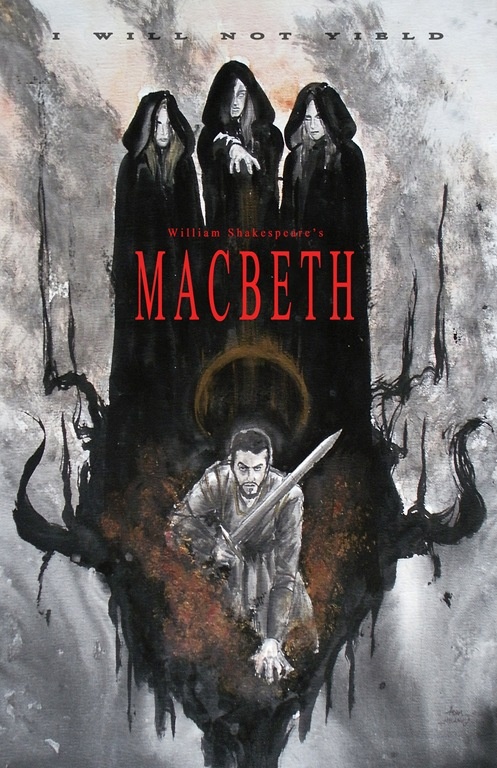
The Hamartia of Macbeth is ambition. Macbeth receives prophecies from the three witches, stating that he will become the Thane of Cawdor and then king there after. After King Duncan awards Macbeth with the title Thane of Cawdor, Macbeth’s ambition rises as he craves more, King of Scotland. Lady Macbeth convinces her husband the only way that prophecy can come true is if Macbeth assassinates Duncan. Macbeth’s destructive obsession with ambition is evident when he is contemplating assonating King Duncan. Macbeth’s ambition starts out as a positive trait for him because he wants to achieve great things and eventually be the King for the great Country of Scotland, however, this positive ambition converts into negative traits. He wants to become the king of Scotland by any means. He kills so many people to fulfill his dream. This dreadful ambition leads him to his tragic death.
Macbeth's Seizing Of Power and subsequent destruction, both his rise and his fall the result of blind ambition.
Ambition in Macbeth analysis:
It is normal to think that ambition is a positive trait and it is something that people aspire to have, but too much can cause people to not think about their actions. This is definitely the case in Shakespeare 's play Macbeth. Macbeth shows that too much ambition can be negative. In addition he becomes disloyal and shows signs of betrayal. Macbeth, perfectly honest, admits that Duncan is a great king and is good for Scotland. But due to the surplus of thoughts, ignited by the prophecies, he tampers with this idea of becoming king. These thoughts of ambition lead to the murder of Duncan, which will start his reign of terror and madness, resulting in his tragic death.
Hamartia of Oedipus:
The Hamartia of Oedipus is an 'error' which consisted of Oedipus's ignorance of his true parentage. His hamartia, or downfall, is his unintended wrongdoings. While Oedipus displays excessive pride, hastiness, and anger, his ultimate downfall comes with a series of unfortunate misjudgments that are made as he continuously aims to do the right thing.
Hamartia plays a large role in 'Oedipus The King'. In the story of Oedipus, the audience is told that Oedipus has left the home of his supposed parents, Polybus and Merope. He does this because he is told by an oracle that he will kill his father and marry his mother. He wants to do everything he can to avoid this fate, so he leaves.
To a Greek audience, this move would have seemed foolish. The Greeks believed that a person cannot escape their fate, so running would do Oedipus no good.
While fleeing, Oedipus comes upon a carriage. The men insult Oedipus, so he waits for them to pass, hides, and kills them. One of these men is King Laius. Oedipus does not know that this is the king and that he is his real, biological father. Here, Oedipus lets his rashness and anger overtake him when he feels he had been slighted and via his hubris, makes decisions about who lives and dies.
The killing of the king ultimately brings a curse on Thebes. When Oedipus arrives in Thebes, he is able to free the townspeople from the curse of a Sphinx. The townspeople thank Oedipus for this and despite being told his fate was to marry his mother, he nevertheless takes Laius’s wife, Jocasta, as his new wife.
This is an example of hamartia. He makes a rash decision to marry Jocasta, this is particularly rash because he had been told that he would marry his mother. Although he does not know that Jocasta is his mother, he does know that she is of an age that she could be his mother.
When a plague hits Thebes, Oedipus seeks out the blind soothsayer, Tiresias. While Tiresias is blind physically, he does have the ability to see what will happen. He tells Oedipus that the reason for the plague is himself, he says Oedipus has killed King Laius. Others advise Oedipus to stop in his pursuit of the truth, but he refuses to give up. He believes he is doing what is best, but he is also unknowingly bringing about his own downfall. Knowing he has killed a man, humility could allow him to realize it is possible that person had been the king, but he refuses to believe it.
He learns that his parents, Laius and Jocasta, had received the same prophecy he did, that their child would kill his father and marry his mother. To avoid this fate, they bound him up and sent him away as an infant. Unbeknownst to them, he was given to Polybus and Merope to raise.
Hamartia of Hamlet:
Hamlet’s fatal flaw is his failure to act immediately to kill Claudius, his uncle and murderer of his father. His tragic flaw is ‘procrastination’. His continuous awareness and doubt delays him in performing the needs. Hamlet finally kills Claudius but only after realizing that he is poisoned. His procrastination, his tragic flaw, leads him to his doom along with that of the other characters he targets. But Hamlet is not responsible for the events which complicate the plot. Fate, chance and the supernatural also play a critical role in Hamlet.
Hamartia of Othello:
Othello's hamartia, or internal tragic flaw, is his extreme jealousy. It is this jealousy that enables him to be tricked and allows him to create his own destruction. Othello was a powerful leader who deeply loved his faithful wife. He was tricked into believing his wife had cheated on him. His suspicion then overpowered him and he murdered his wife in a jealous rage, never even giving her a chance to defend herself. When he discovers he was deceived, he remains a noble character. He realized everything was his own fault and punished himself by committing suicide.
Hamartia of King Lear:
King Lear's Hamartia is his blinded judgement and pride. King Lear's downfall occurs when he starts going crazy because he gets kicked out of both Goneril and Regan's castle. In the play King Lear, William Shakespeare depicts the main character Cordelia as a tragic hero in this story.
King Lear is a tragedy written by William Shakespeare. It depicts the gradual descent into madness of the title character, after he disposes of his kingdom giving bequests to two of his three daughters based on their flattery of him, bringing tragic consequences for all.
Conclusion:
After all this discussion, we can say that Hamartia is the characteristic of great tragedy. According to Aristotle, Hamartia means 'to err' or error of judgement. Macbeth's Hamartia is his dreadful ambition, Qedipus's Hamartia is unknowingly wrongdoing, Hamlet's Hamartia is indecisiveness, Othello's Hamartia is his extreme jealousy and King Lear's Hamartia is his blinded judgement and pride.
References:
Britannica, The Editors of Encyclopaedia. "domestic tragedy". Encyclopedia Britannica, 19 Feb. 2016,https://www.britannica.com/art/domestic-tragedy. Accessed 6 October 2022.
Haupt, G. E. “A NOTE ON THE TRAGIC FLAW AND CAUSATION IN SHAKESPEAREAN TRAGEDY.” Interpretations, vol. 5, no. 1, 1973, pp. 20–32. JSTOR,http://www.jstor.org/stable/23239812. Accessed 2 Oct. 2022.
Reddy, Indira, Tragic Flaw in Shakespeare's Hamlet (August 5, 2015). The IUP Journal of English Studies, Vol. IX, No. 4, December 2014, pp. 93-97, Available at SSRN: https://ssrn.com/abstract=2640004
Stinton, T. C. W. “Hamartia in Aristotle and Greek Tragedy.” The Classical Quarterly, vol. 25, no. 2, 1975, pp. 221–54. JSTOR, http://www.jstor.org/stable/638320Accessed2 Oct. 2022.
Word count: 2194
Images: 10